The Secret Science of the Flute: From Fluid Dynamics to Melodic Magic
For thousands of years, the flute has captivated human culture, yet the physics behind its "simple" operation is remarkably complex. While it may look like just a tube with holes, the flute is a masterclass in fluid dynamics and aero-acoustics. From the way your breath breaks against the edge to the hidden standing waves inside the bore, here is how a flute actually works.
1. The Spark: The Unstable Air Jet
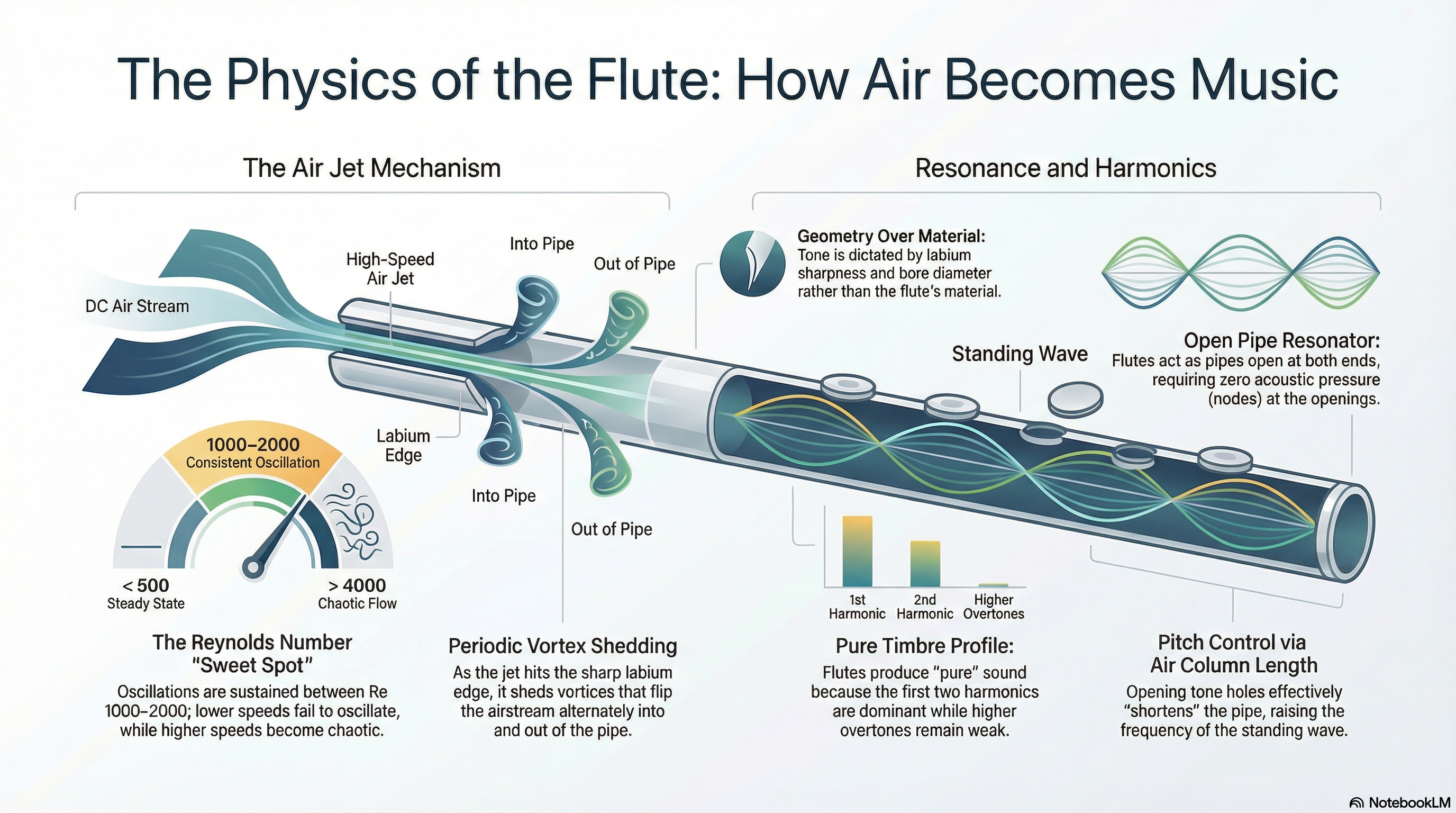
Sound production in a flute doesn't start with a vibration like a reed or a string; it starts with an unstable jet of air. When a flutist blows across the embouchure hole, the air jet strikes a sharp edge called the labium. Recent research using 2D Direct Numerical Simulation has shown that this jet doesn’t just split in two; it oscillates. This "fluttering" is highly dependent on the Reynolds number (Re)—a measure of flow velocity and viscosity. • Too low (Re < 500): The air just grazes the labium with no oscillation—effectively silence. • The Sweet Spot (Re 1000–2000): Consistent, sustained oscillations occur, creating the "edge tone" that powers the instrument. • Too high (Re > 4000): The flow becomes chaotic and turbulent, making the sound erratic. The angle of the labium also matters. Sharper angles (like the 15-degree edges found in recorders) produce more impulsive vortex shedding and more frequent oscillations compared to blunter edges.
2. The Body: The Flute as an Open Pipe
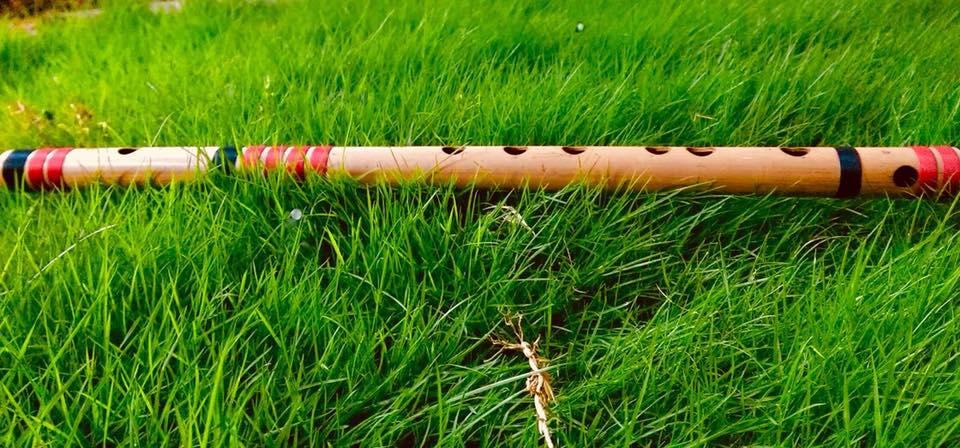
Once those oscillations begin, they couple with the air column inside the flute. Most flutes (like the concert flute or the Indian Bansuri) function as open organ pipes, meaning they are open to the atmosphere at both ends. Inside the tube, a standing wave is formed. Because the ends are open, the air pressure at those points must be atmospheric, creating pressure nodes (points of zero acoustic pressure). For the first resonance, the maximum pressure variation (the anti-node) occurs exactly in the middle of the flute.
3. Changing the Tune: Length and Harmonics
To play different notes, flutists use two primary methods: • Shortening the Tube: By opening tone holes, the player moves the pressure node closer to the mouthpiece, effectively shortening the "working length" of the flute and raising the pitch. • Overblowing: By blowing harder or narrowing their lip aperture, players increase the jet speed to reach harmonics. This allows them to play a higher octave using the same fingering. In an open pipe, these resonances occur in a simple 1:2:3:4 ratio.
4. The Great Debate: Material vs. Design
A common question among musicians is whether a gold, silver, or wooden flute sounds "better." While many swear by the "warmth" of wood, scientific studies suggest the material itself makes minimal difference in the actual tone. What truly defines the sound is: • Bore Size: A larger diameter creates a richer fundamental frequency, leading to a "thicker" and warmer tone. • Embouchure Design: A metal flute’s ability to have a more precisely sharp lip plate makes it easier to create a "focused" and loud sound. • Bore Shape: Whether the tube is perfectly cylindrical or slightly conical (like some Irish flutes) significantly affects how the nodes vibrate and how the instrument is tuned.
Conclusion
The next time you hear a flute, remember that you aren't just hearing a melody—you are witnessing a precise balance of fractional-step fluid simulations and harmonic resonances. Whether it's a 40,000-year-old bone flute or a modern Boehm masterpiece, the science of the "air-reed" remains one of the most elegant intersections of physics and art.
Stay Tuned to the Reed
Join thousands of students and enthusiasts. Receive monthly Raga tutorials, flute care wisdom, and exclusive course updates directly in your inbox.
No Spam · Only Wisdom · Unsubscribe anytime